Wednesday, 21 August 2013

"cyber being - cyber dreaming"


In the digital age, can we not have a cyber dreaming? I don't think this is an unreasonable proposition if another man made creation - that of money, can be associated with such an idea (Chatwin, 1987, p. 12).  Unfortunately, this abstract concept will do little to help one understand the complexities of the virtual self.  A virtual self is not real, it is merely a reconstructed projection of one's own being or identity.  The virtual self's identity, like one's own being is constructed through the perception of others. What differs in this regards, is that those contributing to the identity of our virtual self, do so through the values, ideologies, and discourse of another virtual self.  


Figure 1
The virtual self has its own narrative, and these "self narratives, like maps, are constructs for a particular purpose and context" (Van Luyn, 2013,). In the online game "Grepolis" one of my many virtual self's was a powerful player, one of the leaders in a major alliance.  I had friends, enemy's, would bully, was bullied, liked by some and hated by others. We can now begin to understand that "the mutual (and coercive) production of networked lives invites a reconsideration of how we read and create lives in an online context" (McNeill, 2012, p.  116). 


Power was a central determining factor in how I was perceived within this virtual network. This power was produced primarily by spending the most time online, in the guise of a virtual self - and was reinforced by others. If one is to believe that "Dreaming determines not only what life is but also what it can be" (Stanner, 1979, p. 29), can cyber dreaming not provide an avenue to experience an alternate reality?  


References:

Chatwin, B. (1987). The songlines. London: Jonathan Cape.


McNeill, L. (2012). There is no “I” in network: Social networking sites and posthuman auto/biography. p 101-118.


Stanner, W. E. (1979). White man got no dreaming: essays, 1938-1973. Canberra: Australian National University Press.


Van Luyn, A. (2013). BA1002: Our Space: Networks, narratives and the making of place, Lecture 4:  Networked narratives. [PowerPoint slides]. Retrieved from http://learnjcu.edu.au


Image Credit:

Figure 1. [virtual self]  retrieved from: http://b7-publishing.com/baz/bazaar/index.php?show=eGraphics&base[condition]=leading&base[code]=78765&base[width]=645&base[height]=222


Tuesday, 20 August 2013

Like for a like: The need for virtual validation

Facebook's request for removal tool

In this week’s lecture, Dr Van Luyn (2013) discussed that concept of identity creation in the digital world, stating: “in a virtual network you are not the only person constructing your identity … you’re being told how to create your story.” On first glimpse, it may seem that you have control over the way you are presented on Facebook, but on closer inspection, this is not the case.

Dr Van Luyn’s ideas support McNeill’s (2012, p104) comments regarding the Facebook profile, whereby “the existence of the provided fields sets up self-conceptualizations in particular Facebooked ways, in keeping with the site’s idea of its imagined and ideal members.” Therefore, when we create a Facebook profile it is not a pure act of self-creation, but rather a creation that is conceptualized in a western, middle-class, capitalist way (McNeill, 2012, p 106).

McNeill (2012, p107) also argues that we not only produce our own life stories in this virtual network, but also consume and add to the life stories of others by liking, sharing, and commenting on their posts, thereby participating in a networked auto/biography. During my time as a Facebook (FB) member, there have been occasions when I have felt that an event or experience in my life is more worthwhile if other FB friends like or comment on it.  However, once the event is shared on my profile page, it is not solely my experience anymore but the experience of my whole virtual network. My ownership and control over my own experience diminishes and all the while I am subconsciously waiting for my FB friends to validate it. I know, it sounds weak, but there it is, and I never fully realised before how pervasive the need to post about anything of consequence is.

Vaas (2012) comments on another FB activity that results in networked identity: photo tagging. Vass writes: “many Facebook users want to simply block anyone from tagging them without having received express prior permission to do so. Unfortunately, Facebook has failed to give us this blanket tag-blocking ability.” With the ability of FB friends to tag photos and post our location details we lose more control over our privacy. For some people this loss of individual control may be enough for them to close down their account altogether, but for most of us, the terror at being excluded from the biggest social network we've ever been a part of is too great and so we stay, for as Chatwin (1987, p14) put it, to “exist is to be perceived.” 

Reference List

Chatwin, B. (1987). Songlines. London, England: Jonathon Cape.

McNeill, L. (2012). There is no “I” in network: Social networking sites and posthuman autobiography. Biography, 35(1). 101-118.

Van Luyn, A. (2013). BA1002: Our Space: Networks, narratives and the making of place, Lecture 4: Networked narratives. [PowerPoint slides]. Retrieved from http://learnjcu.edu.au

Vaas, L. (2012). Facebook privacy control overhaul will remove ability to limit who can find us. Retrieved from: http://nakedsecurity.sophos.com/2012/12/12 /facebook-privacy-control-overhaul-will-remove-ability-to-limit-who-can-find-us/

Image Credits

Vaas, L. (2012). Request removal tool. Retrieved from http://nakedsecurity .sophos.com/2012/12/12/facebook-privacy-control-overhaul-will-remove-ability-to-limit-who-can-find-us/

What a good read


My network I chose to explore is a book site called Goodreads. I am already a member of a different book site but I was interested to see how a different network with the same basis operates. It was easy to join because as with most sites all I needed was my name, a password and an email address. I was given the option to create a username but chose to use my first name as I feel more comfortable with this. The site was well labeled, easy to navigate and contained useful information.

The site gives the user the option to connect using either their Facebook, Twitter or Google accounts so, as it states, you can connect with your friends who may already use the site. Even if you choose not to use this option when signing up it appears in the login box every time you enter in case you decide to change your mind.  A further feature allows the site to post your activities on your page for the social network you have signed in with so that your ‘friends’ can see what you have been doing. This provides a connection between two different networks and allows Goodreads access to more information on you and your preferences.

I am not particularly fond of this function as it is interconnecting everything we do and seems to be a way to gather and gain even more information on users. It ties in with what Theresa was speaking about in the lecture in regards to how businesses and companies,  through various methods, are using the choices we make while shopping or networking online to specifically target the preferences of the individual (Petray, 2013). It is almost like the panopticon proposed by Jeremy Bentham (Turkle, 1995) except in a more modern setting. This may not bother some people, due to the easy factor of having one login, but it worries me as we are losing our right to the traditional form of privacy and I find this disempowering.

Petray, T. (2013). BA1002. Our space: Networks, Narratives and the Making of place. Week 3. [Audio Recording]. Retrieved from http://learnjcu.edu.au

Turkle, S. 1995. Life on the Screen: Identity in the age of the internet. Simon and Schuster Paperbacks, New York.

Friday, 16 August 2013

The virtual supermarket
By Bronwyn Harvey

Are YOU a Facebook addict? Do you check your newsfeed as soon as you wake up and continuously throughout the day and night? Facebook is a huge part of everyone’s lives. It allows us to share photos, statuses, information – share just about everything! Facebook allows us to be whoever we want either ourselves or a new persona. However, majority of people, including myself, use our own identities to connect with our real life friends and family and meet new people in other parts of the world. Facebook joins the dots of people connected in this virtual network as demonstrated by the mutual friends lists (Buchanan, 2002).
Image 1: The Supermarket Experience
Facebook is a bit like a supermarket, a home range where we feel like we can go anywhere we want. We can travel freely up and down the aisles browsing through all the products available just like browsing through our newsfeed (Petray 2013). Everyone has power and this is evident in the way the Facebook designers have created Facebook to allow us to defend our page, our territory, as we are empowered to control who has access to our page by either blocking or accepting people. (Petray, 2013). However, there is a bit of a panoptic effect as there is always someone watching our every move but we can’t see them. Security cameras allow supermarket managers and security guards to watch us shop just like Facebook has system administrators who monitor our actions and restrict our travelling abilities. Knowing we are constantly under surveillance we behave in an appropriate manner (Turkle, 1995). This panoptic effect makes us feel like we have the power of doing what we want but really our power is restricted and controlled by the “bosses” who have greater power than we do.

Facebook users are the flâneurs of the virtual network. We can browse through our pages and other people’s pages determining whether we read a status or look at a photo. We determine whether something is interesting or not (Benjamin, 1928) But just like in a supermarket we can’t see EVERYTHING that is going on around us (Wood et al, 2006). Even under surveillance nasty people like paedophiles or stalkers blend in with other Facebook users travelling through this virtual network undetected.
Regardless of all the bad stuff that can happen in a virtual network, Facebook is a great tool for us to socialise and exercise our power in the way we interact with others, so start Facebooking!

 
References
Benjamin.,W. (1928) One Way Street [Einbahnstrasse], Rowohlt, Berlin.

Buchanan, M. (2002) Strange Connections, In Buchanan. M, Nexus: Small Worlds and the Groundbreaking Science of Networks.(pp. 23-33) New York: Norton & Company.

Petray, T. (2013). BA1002. Our space: Networks, Narratives and the Making of place. Week 3. [Audio Recording]. Retrieved from http://learnjcu.edu.au

Turkle, S. (1995). 'Panoptican.' In life on the screen: Identity in the age of the internet. New York: Simon & Schuster

Wood, D., Kaise, W.L, & Abramms, B. (2006). Seeing through maps: Many ways to see the world. Oxford, UK: New Internationalist.
Image credits:

Ashraf, A. (2011), The Supermarket Experience, Retrieved from http://expatlog.com/2011/11/07/the-canadian-supermarket/

Lurking around Facebook By Gabrielle Bennett

Facebook is the most popular online social network for diverse individuals and organizations. It provides instant availability and high level of capacity. It was founded in 2004 by Mark Zucherberg and co-members. The site allows any user who declares they are 13 years of age and over to become registered members. Facebook gives people the power to share and make the world become more open and connected. Just like the food chain, facebook is the survival for communication in contemporary society. https://www.facebook.com/

Image 1: Facebook Login Page (2004) 


Facebook allows me to feel empowered because I can turn my account to 'friends only' or 'public;' allowing me to have the power in regards to who visits my profile page and personal data. "People are placed by power, but they experience it at first hand through the rhythms and relationships of particular places" (Allen, 2003, Pp. 3)

At the moment I am travelling through the virtual network like a fish in the sea. I have explored all the different features such as uploading photos, sharing statuses, 'liking' group pages and even exchanging private/public messages. The social network allows me to feel like I am flying through the sky with no clouds surrounding me; the freedom is powerless opposed to the freedom you have down on the cities sidewalks. "Space is freedom" (Tuan, 1977, pp.3).

Although I am only a beginner at this social network, the designers of facebook have created a self explanatory map in regards to navigating around the 'space' of this network; as every map serves a purpose (wood, 2006). Through the mapping design of facebook it empowers me to visualise divers aspects through the categories that are displayed such as 'news feed.' This permits cyber stalking (Barnes, 1997), as I can prowl around other's pages without them knowing I have even looked. However the hidden prowl is revealed when I contribute to conversations which than link to my profile. Facebook is always under surveillance (Petray, 2013 & Turkle, 1995).

Gtg Blog Later..... Gabbi


Reference list

Allen, J. (2003). Lost geographies of power. Malden, MA: Blackwell.

Barnes, G. (1997). Passage of the cyber-flaneur. Retrieved from http://www.raynbird.com/essays/passage_flaneur.html

Petray, T. (2013). BA1002. Our space: Networks, Narratives and the Making of place. Week 1. [Audio Recording]. Retrieved from http://learnjcu.edu.au

Turkle, S. (1995). 'Panoptican.' In life on the screen: Identity in the age of the internet. New York: Simon & Schuster.

Tuan, Y. (1977). Introduction, in space and place: The perspectives of experience. (pp 3-7). London, England: Edward Arnold.

Wood, D., Kaise, W.L, & Abramms, B. (2006). Seeing through maps: Many ways to see the world. Oxford, UK: New Internationalist.

Image Credits

Image 1: Facebook Login Image. (2004). Retrieved from http://www.facebook.com/
)

"The fiction effect"

Figure 1
"Cyberspace, in the form of the Internet, is a prison in that it is a captivity without boundaries" Barnes (1997).   If cyberspace is indeed a prison, it is a prison lacking punishment - a prison where incarceration is not forcibly imposed, rather sought after. Take an online, multiplayer game for example - one that you are most likely not familiar with - its name is Grepolis. Grepolis is a browser based game, free to play, based on Greek mythology. The goal is to build magnificent cities, forge mighty alliances, and conquer the world.


All this takes place on a server, known as a "world" and is populated by thousands of real players from different countries. The immersive potential of this most simplistic of virtual environments cannot be underestimated. In fact, "our capacity to immerse ourselves in a symbolic element has developed to where we hardly even notice the disappearing act" Heim (1993). Its when this "disappearing act" begins to interfere with RL (real life) commitments that a player has to re-evaluate their self imposed captivity - punishment is now a real possibility from external factors. 

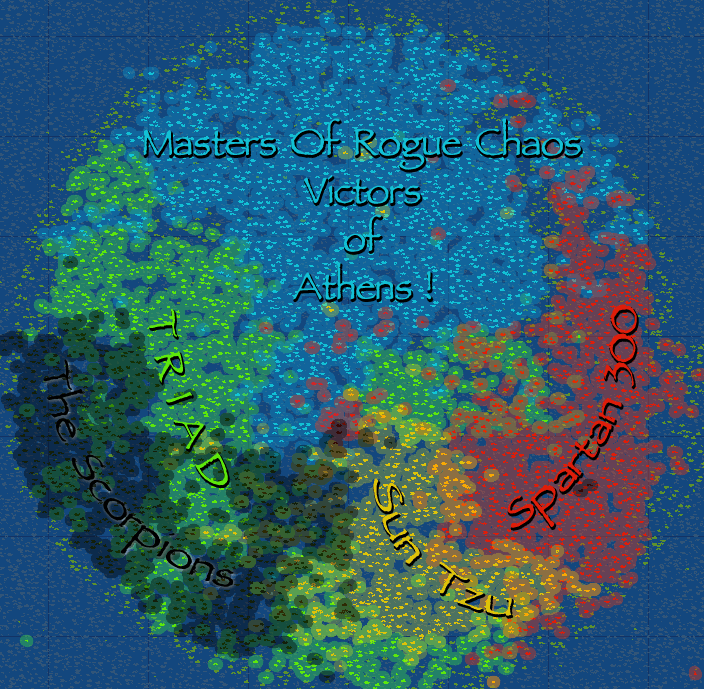
Grepolis relies heavily on a "world" map for gameplay. A player must amass multiple cities, located on multiple islands within this map. Wood (2006) points out the importance of maps by stating, "Every map serves a purpose, every map advances an interest" (p.4). This can be seen clearly in the map driven gameplay of Grepolis, rewarding those players who master it. Furthermore, maps shape understandings of space, place and power (Petray, 2013, 3.1 Maps), ref to figure 1, showing the top 5 alliances on one of the many Grepolis servers.

Although Prouty (2009) might think "the flâneur as an historical figure ended ignobly", it's genesis lives on, nobility restored, and free to roam cyberspace, or the world map of Grepolis as freely as the arcades of yesteryear.


References 
Barnes, G. (1997). Passage of the Flaneur. Retrieved from http://www.raynbird.com/essays/Passage_Flaneur.html
 
Heim, M. (1993). The metaphysics of virtual reality. New York: Oxford University Press
 
Prouty,R.(2009). A Turtle on a Leash. Retrieved from http://www.onewaystreet.typepad.com/one_way_street/2009/10/a-turtle-on-a-leash.html

Petray, T. (2013, 3.1 Maps). BA1002: Our Space: Networks, Narrative and the Making of Place, week 3. [Audio Recording]. Retrieved from http://learnjcu.jcu.edu.au
 
Wood, D., & Kaiser, W. L. (2006). Seeing through maps: many ways to see the world. Oxford: New Internationalist.


Image Credit 
Figure 1, World Map in Grepolis. Retrieved from: http://i882.photobucket.com/albums/ac28/philipv/AthensFinalMap.gif